
Eto’o to Ben Barek: The 5 African Players Who Scored the Most in LaLiga

By Fayokun Goodness
The 2026/27 LaLiga season has begun. The first round of matches was played on 15 August, bringing another generation of players into one of European football’s biggest stages.
African players have been part of that story for decades.
African success in La Liga does not follow a set script. It includes prodigies discovered in adolescence who have gone on to become household names, as well as late bloomers who have found their ideal environment. African football features both native-born and diaspora players, such as Iñaki Williams, who was born in Bilbao but proudly represents his Ghanaian heritage on the pitch.
And then there is Larbi Ben Barek, who was scoring goals in Madrid more than 70 years ago.
These careers span many different eras of Spanish football. They also tell a larger story about how African players got into La Liga, whether through migration, youth development, family ties, or simply the ability to make a name for themselves.
So, who has scored the most?
Make no mistake: this is a goalscoring leaderboard, not an arbitrary ranking of greatness. Positioning here comes down to cold finish numbers, but every strike on this list tells a distinct story of African dominance in Spain.
1. Samuel Eto’o, Cameroon: 162 goals
No African player has come close to Samuel Eto’o’s LaLiga goals.
The Cameroonian scored 162 goals in 280 league appearances for Real Madrid, Mallorca, and Barcelona, placing him among the competition’s top all-time leading scorers.
Real Madrid gave Eto’o his first taste of Spanish football, signing him as a teenager. He joined the youth academy and went on loans to Leganés, Espanyol, and Mallorca. He joined Mallorca permanently in 2000 and scored 54 LaLiga goals for the island club before joining Barcelona in 2004.
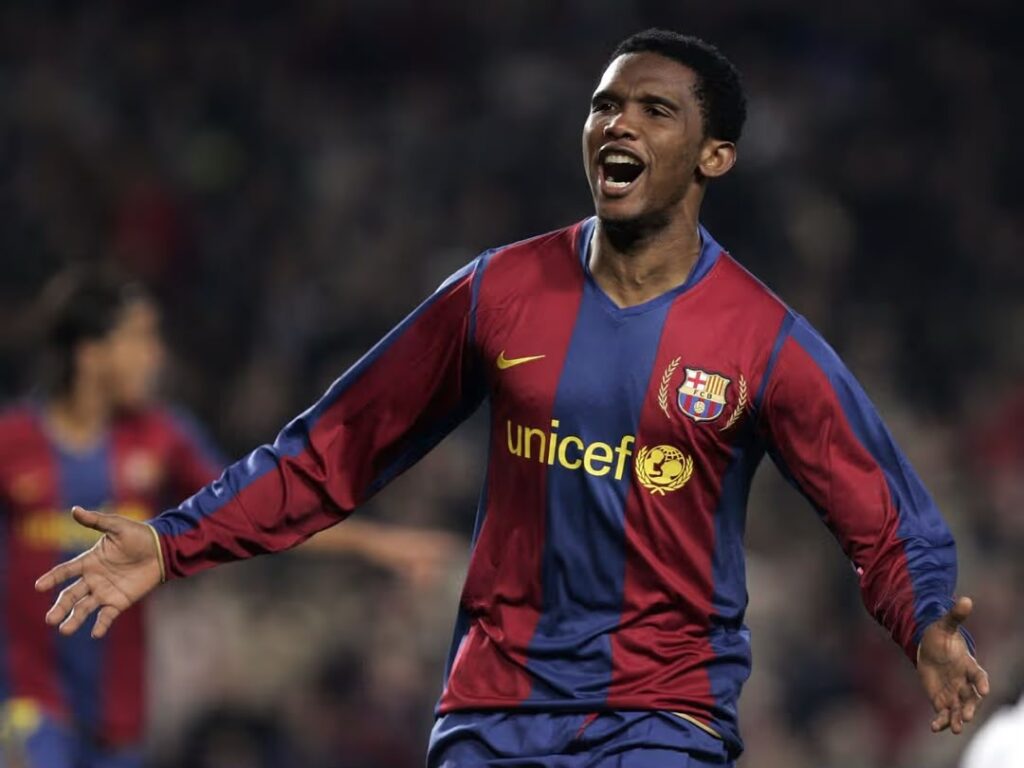
In Eto’o’s first season at the Camp Nou, he scored 25 LaLiga goals and won a league title. He scored 26 times in the following season and finished as the league’s top scorer. Barcelona also won the Champions League that season, beating Arsenal in the final, with Eto’o scoring the equaliser in a 2-1 victory.
He scored 30 LaLiga goals in 2008/09 and finished the season with 38 goals in all competitions as Barcelona won LaLiga, the Copa del Rey, and the Champions League. He also scored in the Champions League final 2-0 win against Manchester United.
His individual accolades matched the numbers. Eto’o finished third in the 2005 FIFA World Player of the Year voting and was selected in the FIFA FIFPro World XI in 2005 and 2006.
That is why his 162 goals stand out. The number is not just a record. It is the footprint of an African forward who became one of the defining strikers of modern LaLiga.
2. Frédéric Kanouté, Mali: 89 goals
In May 2006, Frédéric Kanouté came off the bench in Sevilla’s UEFA Cup final against Middlesbrough and scored the fourth goal in a 4-0 victory.
Kanouté also scored in the 2006 UEFA Super Cup against Barcelona as Sevilla won 3-0.
A year later, he scored again in the UEFA Cup final.
This time it was against Espanyol. Kanouté put Sevilla 2-1 ahead in extra time before the match went to penalties. Sevilla won the shootout and became the first club since Real Madrid in 1985 and 1986 to win consecutive UEFA Cups.
Those moments capture the Malian’s place in Sevilla history.
Kanouté joined from Tottenham in 2005 and spent seven seasons in Spain. He scored 89 LaLiga goals in 209 appearances, with his best league return coming in 2006/07 when he scored 21 times.
By 2007, Kanouté had become important enough at the club and international level to win the African Footballer of the Year award. He beat Didier Drogba and Michael Essien to the prize.
3. Iñaki Williams, Ghana: 85 goals
Iñaki Williams’ name comes with a record before you even get to the goals.
Between April 2016 and January 2023, he played 251 consecutive LaLiga matches for Athletic Club. He did not miss a league game for almost seven years. A hamstring problem finally ended the run against Celta Vigo in January 2023.
After 6 years, 251 consecutive games, Inaki Williams will now miss one La Liga game with Athletic Club as he won’t be involved against Celta Vigo due to muscle injury. 🔴⛔️ #LaLiga
— Fabrizio Romano (@FabrizioRomano) January 29, 2023
Last time he didn’t play was April 7, 2016 vs Malaga. pic.twitter.com/0VQ6kWv7j7
Williams has since added another milestone to the record book.
In March 2026, he made his 500th official appearance for Athletic in all competitions. He became only the eighth player in the club’s history to reach the mark. He had scored 114 goals across those competitions at the time.
For this ranking, however, we are counting only LaLiga. Transfermarkt currently has Williams on 85 goals in 407 LaLiga appearances. His 2025/26 season added three more league goals to his total.
This ranking has one of its most obvious African diaspora threads thanks to Williams’ story.
His parents were from Ghana and had travelled to Spain prior to his birth. He was born in Bilbao. His parents eventually arrived in Melilla after travelling through a portion of the Sahara before getting assistance that took them to Bilbao. Before settling at San Mamés, Williams, who was raised in Pamplona, participated in Athletic’s youth programme.
He was a youth player for Spain and made one senior appearance in a friendly in 2016. He made his debut for the Black Stars in Ghana in 2022.
Despite having Spanish roots throughout his football education and club career, Williams is African due to his Ghanaian ancestry and senior international allegiance.
4. Youssef En-Nesyri, Morocco: 69 goals
Youssef En-Nesyri’s route into LaLiga began at the Mohammed VI Academy in Morocco.
Málaga noticed him and brought him to Spain as a teenager. He moved through the club’s youth structure before breaking into the first team. He later moved to Leganés and then joined Sevilla in January 2020.
It is important to understand this pathway because En-Nesyri was part of a Moroccan football connection with Spain.
Noureddine Naybet spent eight years at Deportivo La Coruña and helped the club win LaLiga in 2000. Youssef El Arabi later became Granada’s leading scorer in the Spanish top flight. By the time En-Nesyri arrived, Morocco already had a long line of players who had built careers in Spanish football.
En-Nesyri eventually pushed that line forward. He scored 69 LaLiga goals in 230 appearances across Málaga, Leganés, and Sevilla. His best league season came in 2020/21, when he scored 18 times for Sevilla.
In 2023, he scored twice against Manchester United in the Europa League quarter-final second leg as Sevilla won 3-0 and advanced to the semi-finals. He scored again against Juventus in the semi-final as Sevilla reached another European final. The club eventually won the Europa League.
When he left Sevilla in July 2024, he had spent four and a half seasons at the club and won two Europa League titles. He moved to Fenerbahçe and left Spain with 69 league goals.
5. Larbi Ben Barek, Morocco: 58 goals
Before Eto’o, Kanouté, Williams, and En-Nesyri. There was Larbi Ben Barek.
The Moroccan joined Atlético Madrid in 1948 and spent five seasons at the club. He scored 58 LaLiga goals in 114 appearances and helped Atlético win consecutive league titles in 1949/50 and 1950/51.
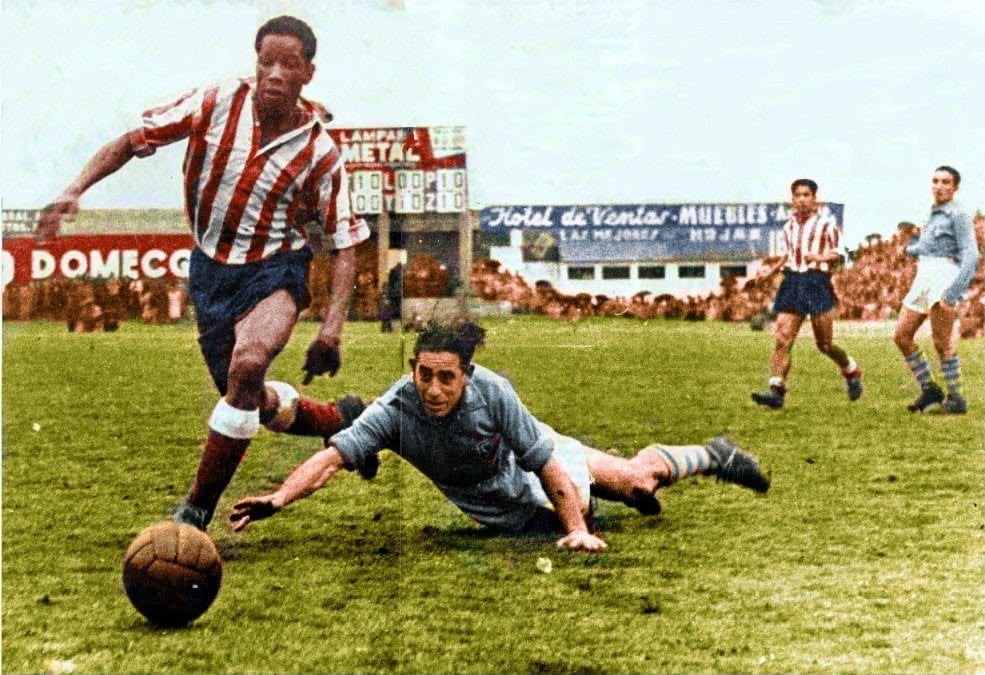
His reputation stretched far beyond Madrid. He was known as La Perle Noire, or the Black Pearl, a name that captured the esteem in which he was held across European football.
Ben Barek had represented regional Moroccan selections in the 1930s, yet after the Second World War he became a French international despite not holding a French passport. He earned 17 caps for France, and the Rec Sport Soccer Statistics Foundation lists him among only four Moroccans to have played for the French national team.
That complicated international history reflects the football world he came through. Ben Barek was Moroccan, born in Casablanca and shaped by Moroccan football, but his career was also formed by French colonial rule and the football structures that connected Morocco to France.
Pelé was reportedly once asked about Ben Barek and gave him the ultimate compliment: “If I am the king of football, Ben Barek is the god of football.”
More than seven decades after his final LaLiga appearance, his 58 goals still place him fifth among the African players in this ranking.
Five Players, One Story
The list begins with Eto’o, who achieved great successes with Barcelona. It ends with Ben Barek, whose performances helped make Atlético Madrid one of the most entertaining sides of his era.
In between are very different African journeys.
Kanouté found a home at Sevilla and became part of the club’s golden period. En-Nesyri came through Málaga’s system and followed a route already familiar to generations of Moroccan players. Williams was born in Bilbao to Ghanaian parents whose journey to Spain shaped the life that followed.
Spain has repeatedly become a destination where those journeys lead to careers.
The goals scored placed those careers in order. The journeys explain why the list is important to remember.
About the Author





0 Comments