
Why Every African Football Federation Should Be Studying Spain’s 2026 World Cup Success
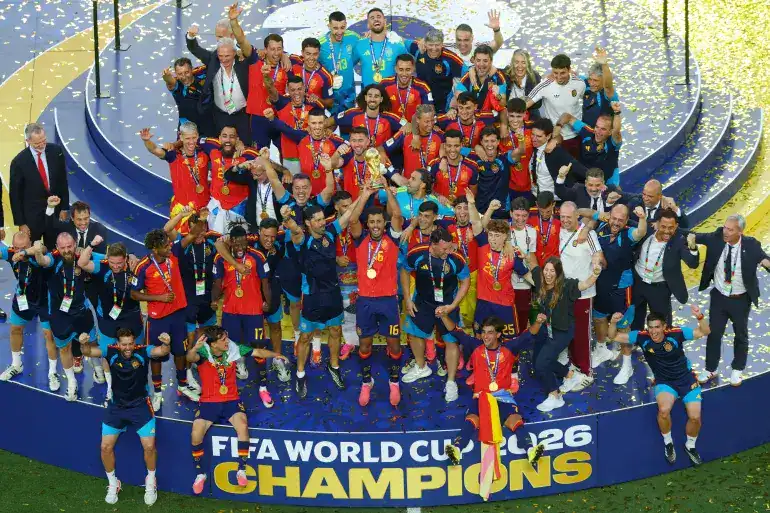
When Spain lifted this year’s World Cup trophy, the conversation quickly centred on tactics, possession football and individual brilliance.
But African football federations should be paying attention to something else entirely. The biggest lesson from Spain’s triumph is not how they play. It is how they plan.
For years, football discussions across Africa have focused on coaches, players and tournament performances. When teams fail, coaches are dismissed. When teams succeed, celebrations follow. Then the cycle starts again.
Spain’s World Cup victory against Argentina offers a reminder that sustained success rarely comes from short-term decisions. It comes from systems that survive individual players, coaches and administrations.
That may be the most important lesson African football can take from this World Cup.
Spain Built A System Before It Became A Champion
Spain’s World Cup success did not begin in 2026. It was years in the making.
The foundations were built through investments in coaching education, youth development, talent identification and a clear football philosophy that extended across different age groups.
The generation that lifted the 2026 FIFA World Cup did not emerge overnight. It was the product of a football ecosystem that has spent decades refining how players are identified, developed and integrated into the national team.
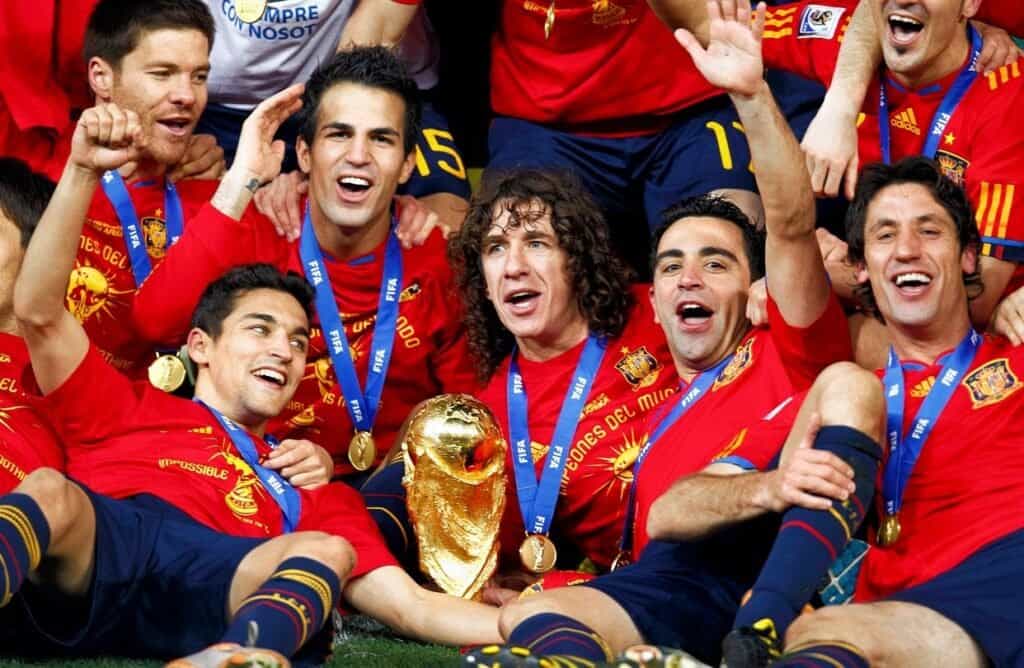
The victory against Argentina was only the final chapter of a much longer story.
Long before Spain reclaimed football’s biggest prize, its football institutions had already established a philosophy that extended beyond individual coaches and generations of players.
Unlike many national teams whose playing identity changes whenever a new manager arrives, Spain has largely maintained a recognisable football identity across different age groups.
Whether watching the under-17s, under-19s, under-21s or the senior side, observers have often recognised similar technical principles, tactical intelligence and positional discipline.
That consistency is not a coincidence. It reflects years of coordination between the federation, professional clubs, coaching programmes and youth competitions.
The national team is not built in isolation. It is the final stage of a development pipeline. Perhaps that is where many discussions about football development in Africa begin to miss the point.
Modern football increasingly rewards countries that build institutions capable of producing excellence repeatedly rather than relying on exceptional generations of players.
Spain’s greatest achievement is not producing talented footballers. Many countries produce talented footballers. Its greatest achievement is producing talented footballers consistently.
The Machinery Behind Spain’s Success
Spain’s football model rests on an idea that sounds remarkably simple but is extraordinarily difficult to execute.
Every stage of player development should prepare footballers for the next one. That philosophy has shaped coaching education, youth competitions, talent identification and technical development for decades.
The country’s elite academies have become global references for player development, not because they produce the occasional superstar, but because they continue producing technically intelligent footballers across multiple generations.
Barcelona’s famed La Masia academy has produced players who transformed both club and international football, including the likes of Xavi Hernandez, Andres Iniesta, Lamine Yamal, Pau Cubarsi and many others. But it is far from Spain’s only success story.
Real Madrid, Villarreal, Valencia and Sevilla have also invested heavily in youth development structures that strengthen both club football and Spain’s wider talent pool.
Each academy has its own identity. Yet together they reinforce a national football culture that values technical excellence, tactical intelligence and player education.
That relationship between clubs and the national federation is often underestimated. Successful national teams rarely exist independently of strong domestic development systems. They depend on them.
Spain’s federation has also placed significant emphasis on coaching education. While football supporters naturally celebrate players, coaches shape almost every stage of a footballer’s development.
Every technically gifted midfielder, disciplined defender or intelligent striker has almost certainly benefited from years of structured coaching long before reaching professional football.
Investment in coaches therefore becomes an investment in every future generation of players. This is one reason Spain continues to regenerate successfully.
Why African Football Federations Should Pay Attention
For African football, Spain’s World Cup victory should not be viewed simply as another European success story. It should be treated as a case study.
For decades, one of African football’s greatest strengths has also been one of its greatest contradictions. The continent consistently produces some of the world’s finest footballers, yet relatively few national teams have managed to sustain success over multiple generations.
The issue is no longer whether Africa has talent. That debate was settled years ago.
From George Weah and Jay-Jay Okocha to Didier Drogba, Samuel Eto’o, Mohamed Salah, Sadio Mané and Victor Osimhen, Africa has produced players capable of competing with, and often outperforming the best footballers in the world.
European football offers even stronger evidence. Every season, African players occupy central roles in the Premier League, La Liga, Serie A, the Bundesliga and Ligue 1, proving that the continent has no shortage of elite talent. In 2022–23, Nigeria’s Victor Osimhen became the first African to win the Serie A Golden Boot. He later finished as the top scorer in the 2024–25 Turkish Süper Lig after joining Galatasaray.
Mohamed Salah won the Premier League Golden Boot in 2017–18, 2018–19, 2021–22, and 2024-25, as he tied Thierry Henry’s all-time record of four Premier League Golden Boot awards.
Mohamed Salah equals Thierry Henry's record of four Golden Boots 🤩 pic.twitter.com/TbcSdq7OJ7
— Premier League (@premierleague) May 26, 2025
Sadio Mané also shared the Premier League Golden Boot award in 2018–19. African footballers have also been named the best players in Europe’s top leagues, won domestic titles, and played decisive roles in UEFA Champions League triumphs.
Yet while Europe consistently benefits from African talent, relatively few African national teams have been able to convert that abundance into sustained success at the highest international level.
The paradox is that while Africa exports elite footballers, it has not consistently exported elite football systems. Too often, national teams rise and fall with a single exceptional generation.
The countries dominating international football today are always planning continuously. Every youth tournament, coaching course and academy intake is treated as part of the next World Cup cycle.
That is perhaps Spain’s biggest lesson. The World Cup is not won every four years. It is won every day between tournaments.
Morocco Has Already Shown Africa What Is Possible
African football does not need to look only to Europe for examples. Morocco has already demonstrated what long-term planning can achieve.
Its historic World Cup run to the semifinals in 2022 was not an accident. It was the result of years of investment in player development, coaching, infrastructure and federation planning.
The Mohammed VI Football Complex became a symbol of a broader strategy rather than a standalone project.
More importantly, Morocco built structures that connected youth development to national team ambitions. The result was not just a successful tournament.
It was proof that African federations can build sustainable football systems when planning is treated as a long-term commitment rather than a short-term campaign.
Spain’s World Cup victory reinforces the same lesson. Success is usually built long before the world notices it.
Lessons Every African Federation Should Take from Spain
Spain’s success should not encourage imitation for its own sake. African football operates in different economic, political and cultural realities. No federation can simply copy another country’s model. But there are principles that travel well.
First, treat football development as a national project rather than a tournament project. Planning should extend beyond the next AFCON or World Cup qualifiers. Federations need clear technical strategies that survive changes in leadership and coaching staff.
Second, invest as heavily in coaches as in players. Elite footballers rarely emerge without elite coaching. Expanding coaching education at grassroots and academy level may produce greater long-term returns than another short-term managerial appointment.
Third, strengthen domestic development pathways. Youth competitions, academies and local clubs should function as connected stages of one football ecosystem. National teams should be the destination of that pathway, not the starting point.
Fourth, measure success differently. Winning tournaments remains the ultimate goal, but federations should also monitor coaching numbers, youth-player progression, academy quality, women’s football development, sports science capacity and governance standards. These are often leading indicators of future success.
Finally, protect continuity. Football philosophies should outlive individual coaches. Development strategies should outlive federation elections. Institutional memory should outlive administrations. That is how successful football cultures are built.
Africa Needs Golden Institutions
For decades, African football has searched for the next great player. Those players will continue to emerge.
The continent has never struggled to produce extraordinary footballers. Its greater challenge has been producing extraordinary football institutions.
Spain’s greatest achievement at the 2026 FIFA World Cup was not simply defeating Argentina in the final or lifting another trophy. It was demonstrating, once again, that sustained football success is rarely built on moments of brilliance alone.
It is built through institutions that continue producing excellence long after individual players, coaches and administrators have moved on.
Africa already possesses many of the ingredients required to compete consistently with the world’s best. The talent is unquestionable. The passion is unmatched. The football culture is deeply rooted in communities from Casablanca to Cape Town, from Dakar to Dar es Salaam.
The next step is institutional. Federations must move beyond managing tournaments to building football ecosystems.
That means seeing football not merely as ninety minutes on a pitch but as an interconnected network of coaching, education, governance, infrastructure, sports science, commercial investment and youth development.
The countries that embrace that approach may not become world champions overnight. But they will give themselves something even more valuable: the ability to compete for football’s biggest prizes consistently rather than occasionally.
Spain’s World Cup victory should not inspire envy across African football. It should inspire reflection. Because the most important lesson from Spain’s triumph is not how the team played.
It is how the country prepared. And for African football federations, that preparation may prove to be the difference between producing another generation of gifted players and building the institutions capable of turning those players into world champions.
0 Comments